 LearnSprout
FREE PRINTABLES
Building Fine Motor Skills by Tracing Lines
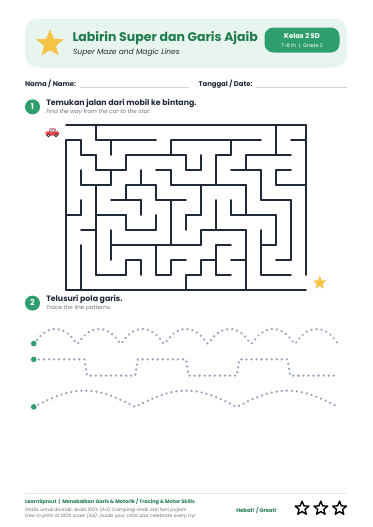
Before writing letters, a child’s hand needs practice controlling small movements. This is fine motor skill: using the muscles of the fingers and wrist with purpose. Tracing lines is a simple exercise that supports it.
Why trace lines?
Straight lines, zig-zags and curves are the basic shapes that later appear in many letters and numbers. By following lines, children learn to control pencil pressure, direction of movement, and eye-hand coordination.
An easy order
- Straight horizontal and vertical lines.
- Diagonal lines and zig-zags.
- Curves and waves.
- Circles and spirals.
- Patterns that combine several shapes.
Start easy. If your child gets frustrated quickly, go back a level and repeat in a relaxed mood.
Extra practice away from paper
Fine motor skills also grow through squeezing dough, using clothes pegs, threading beads, cutting paper and pouring water from a small cup. Vary the activities so your child does not get tired of them.
Tips during practice
- Make sure your child sits comfortably, with feet on the floor or a footrest.
- Use a pencil that is not too hard and is easy to hold.
- Let your child choose the pencil colour. Small choices boost enthusiasm.
- Appreciate lines that wander off the path; what matters is that your child tries.
Common mistakes
- Asking for neat writing too early. Focus first on following the direction of the line.
- Pressuring the child not to go outside the lines. Wandering lines are part of learning.
- Practising for too long so the hand tires.
- Using only pencils, when crayons, markers and finger paint also train the hand.
Sample one-week plan
Monday: horizontal straight lines. Tuesday: vertical and diagonal lines. Wednesday: zig-zags. Thursday: curves and waves. Friday: circles and spirals. Ten minutes each day, plus one non-paper activity such as squeezing dough.
Frequently asked questions
My child’s hand tires quickly. Is that normal? In small children the hand muscles are still developing. Shorten sessions and give breaks.
Do we need a special pencil? Not necessarily. A pencil or crayon that is easy to hold and not slippery is enough.
Printable practice sheets
Use the tracing and fine motor worksheets for 10–15 minute sessions. Print at actual size so the lines stay clear.