Introducing Shapes and Patterns to Young Children
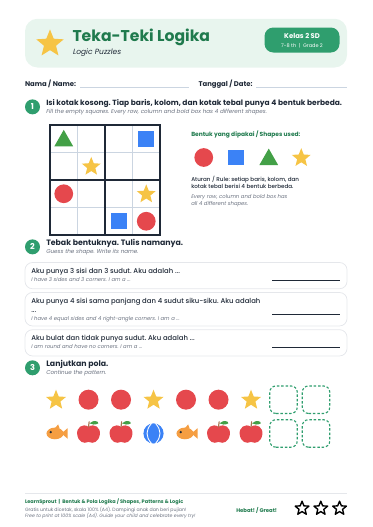
Learning shapes and patterns helps children observe, compare, and guess what comes next. These skills form the basis of logical thinking and later help with mathematics.
Start with basic shapes
Introduce the circle, square, triangle and rectangle. Look for them around you: a wheel is a circle, a window is a rectangle, a roof is a triangle. Let your child hold objects before drawing them.
Understanding patterns
A pattern is an arrangement that repeats. Start with simple A-B-A-B patterns such as red-blue-red-blue, then move to A-A-B or A-B-C.
- Make patterns from beads, buttons or blocks.
- Ask your child to continue a pattern you start.
- Look for patterns in clothes, tiles or batik fabric.
- Make patterns with movement: clap, clap, jump.
Easy logic games
- Finding the odd one out in a group of pictures.
- Matching shadows to pictures.
- Sorting objects by colour, shape or size.
- Simple mazes.
Give thinking time
When your child looks confused, wait a few seconds before helping. Ask, “What do you see?” Discovering the answer themselves makes understanding stronger.
Practice material
There are many pattern, matching and spot-the-difference sheets in the shapes, patterns and logic worksheets. Use them alongside real play.